 +86 21 51096910
 sales@welsobio.com / marketing@welsobio.com




+86 21 51096910
sales@welsobio.com / marketing@welsobio.com
Dairy products, including liquid milk, milk powder, yogurt, fermented milk and other processed dairy products, are widely consumed and are subject to strict quality and safety requirements. During quality control and regulatory testing, potentially harmful elements such as lead (Pb), cadmium (Cd), mercury (Hg), arsenic (As), chromium (Cr), tin (Sn) and nickel (Ni) may need to be determined according to applicable national or regional requirements.
Common analytical techniques for elemental determination include Atomic Absorption Spectrometry (AAS), Atomic Fluorescence Spectrometry (AFS) and Inductively Coupled Plasma Mass Spectrometry (ICP-MS). Before instrumental analysis, dairy samples generally require an effective sample preparation and digestion process to convert complex liquid or solid matrices into a clear solution suitable for elemental measurement.
Because dairy products contain proteins, fats, carbohydrates and other organic components, conventional wet digestion can require relatively long processing times and large amounts of acid. Microwave digestion provides a controlled and efficient approach for the pretreatment of dairy samples. With controlled temperature and pressure conditions, microwave-assisted digestion can accelerate the decomposition of organic matrices while helping reduce acid consumption and improve the consistency of sample preparation.
This application study presents microwave digestion procedures for several representative dairy products using a Welso microwave digestion system, providing a practical reference for laboratories performing elemental analysis of dairy samples.
Instruments and Reagents
Instruments
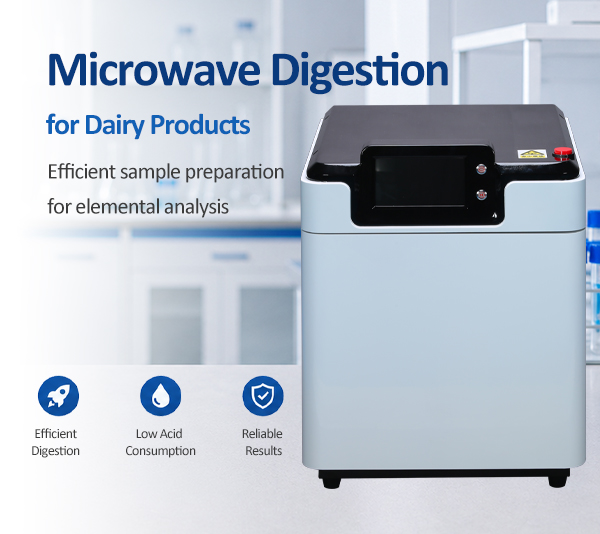
Welso Microwave Digestion System—A programmable microwave digestion solution designed for efficient laboratory sample preparation. Learn more about the product specifications and technical details →
Acid Evaporator / Heating Block
Analytical Balance (0.1 mg readability)
Fume Hood
Reagents
Nitric Acid (HNO₃), 68%
Hydrogen Peroxide (H₂O₂), 30%
Deionized Water
Microwave Digestion Procedures for Dairy Products
Different dairy matrices have different organic compositions and digestion characteristics. Therefore, sample mass, acid composition and microwave digestion conditions should be adjusted according to the sample type.
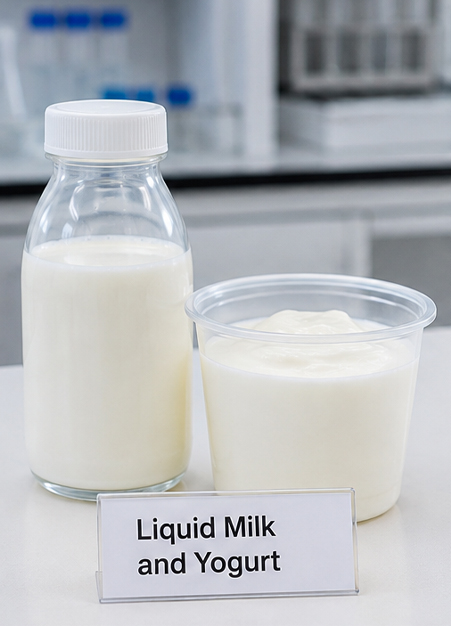
1. Liquid Milk and Yogurt
Accurately weigh approximately 2.0 g of sample to the bottom of the digestion vessel, with a weighing accuracy of 0.1 mg. Add 10 mL of nitric acid.
Place the digestion vessels on an acid evaporator and perform a preliminary treatment at 120°C for 30 min. After the evolution of yellow fumes has subsided, remove the vessels and allow them to cool.
After assembling the digestion vessels, perform microwave digestion using the following program:
Stage | Temperature | Holding Time |
1 | 150°C | 5 min |
2 | 180°C | 30 min |
After digestion, allow the vessels to cool to below 60°C. Transfer them to a fume hood and carefully open the vessels.
Evaporate the digestion solution at approximately 150°C until about 0.5 mL of solution remains. Dilute with deionized water to the required volume.
The resulting digestion solution is clear and transparent, indicating effective decomposition of the sample matrix.
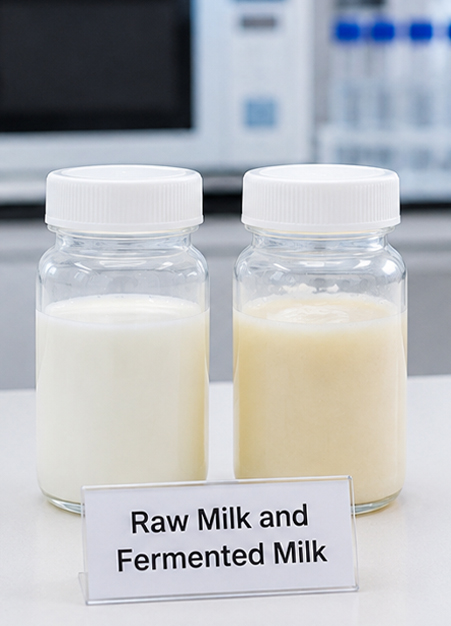
2. Raw Milk and Fermented Milk
For raw milk and fermented milk, weigh approximately 1.0 g of sample with a weighing accuracy of 0.1 mg. Add 8 mL of nitric acid.
Perform preliminary digestion at 120°C for 30 min using an acid evaporator. After the yellow fumes have subsided, allow the sample to cool and add 2 mL of hydrogen peroxide.
Assemble the digestion vessels and perform microwave digestion according to the following program:
Stage | Temperature | Holding Time |
1 | 150°C | 5 min |
2 | 180°C | 5 min |
3 | 200°C | 30 min |
After the digestion program is completed, allow the vessels to cool to below 60°C. Carefully open the vessels inside a fume hood.
Evaporate the solution at approximately 150°C until approximately 0.5 mL remains. Dilute with deionized water to the required volume.
The sample can be effectively decomposed under the described conditions, producing a clear digestion solution suitable for subsequent elemental analysis.
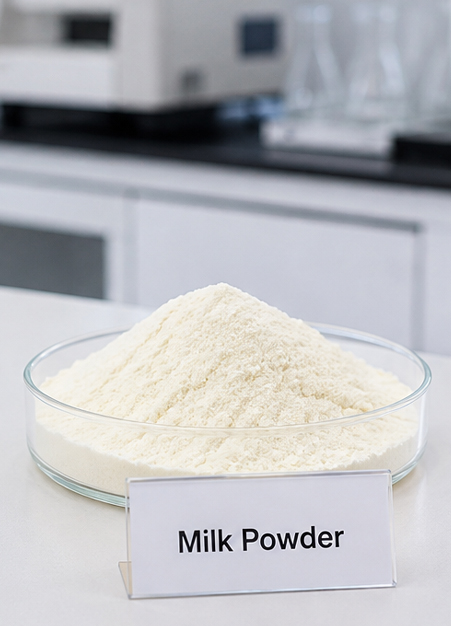
3. Milk Powder
Milk powder has a higher concentration of solids than liquid dairy products, so a lower sample mass is recommended for digestion.
Accurately weigh approximately 0.3 g of milk powder and add 8 mL of nitric acid. Carry out preliminary treatment at 120°C for 30 min using an acid evaporator.
After the yellow fumes have subsided, allow the sample to cool and add 2 mL of hydrogen peroxide.
Perform microwave digestion according to the following program:
Stage | Temperature | Holding Time |
1 | 150°C | 5 min |
2 | 180°C | 30 min |
After digestion, allow the vessels to cool to below 60°C. Carefully open the vessels in a fume hood and evaporate the solution at approximately 150°C until about 0.5 mL remains.
Dilute with deionized water to the required volume. Under the described conditions, the milk powder sample can be effectively decomposed and converted into a clear digestion solution for subsequent elemental determination.
Results and Discussion
The experimental results demonstrate that microwave-assisted digestion can effectively handle different types of dairy matrices, including liquid milk, yogurt, raw milk, fermented milk and milk powder.
For liquid milk and yogurt, a sample mass of up to approximately 2.0 g was treated with nitric acid before microwave digestion. A maximum digestion temperature of 180°C was sufficient to obtain a clear digestion solution.
For raw milk and fermented milk, approximately 1.0 g of sample was pretreated with nitric acid followed by the addition of hydrogen peroxide. The microwave digestion temperature was increased to 200°C, providing effective decomposition of the relatively complex organic matrix.
For milk powder, approximately 0.3 g of sample was used. Nitric acid and hydrogen peroxide were applied in combination, with a maximum digestion temperature of 180°C. The resulting solution was clear and suitable for subsequent elemental analysis.
The results indicate that sample matrix, sample mass, acid composition and digestion temperature are important factors in dairy sample preparation. Selecting appropriate digestion conditions can improve digestion efficiency and provide a more consistent solution for subsequent AAS, AFS or ICP-MS analysis.
Advantages of Microwave Digestion for Dairy Sample Preparation
Compared with conventional digestion approaches, microwave digestion offers several advantages for the elemental analysis of dairy products:
Efficient sample decomposition: Controlled temperature and pressure conditions accelerate the breakdown of organic matrices.
Reduced acid consumption: Optimized digestion procedures can reduce the amount of acid required for sample preparation.
Consistent digestion conditions: Programmable temperature and holding-time control improve the repeatability of sample pretreatment.
Wide sample applicability: The method can be adapted to liquid milk, yogurt, fermented milk, raw milk, milk powder and other dairy matrices.
Suitable for elemental analysis: Clear digestion solutions can be prepared for subsequent AAS, AFS, ICP-MS and other analytical techniques.
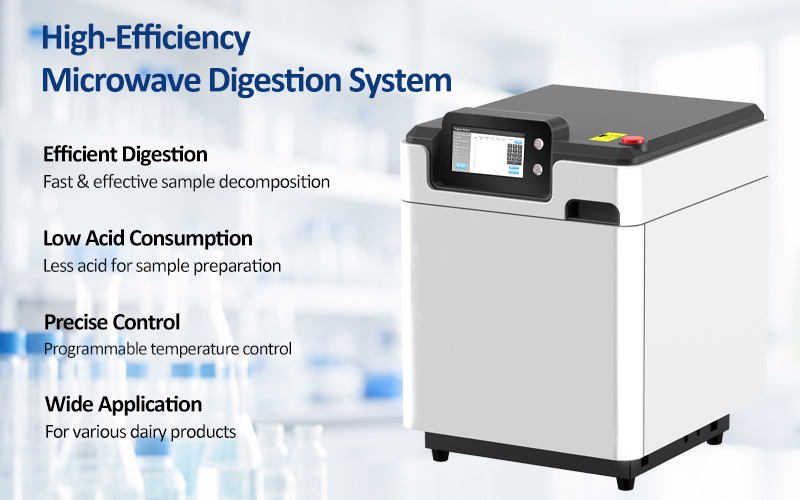
Microwave digestion provides an efficient and controlled sample preparation approach for elemental analysis of dairy products. By combining nitric acid with hydrogen peroxide when appropriate, different dairy matrices can be effectively decomposed under optimized microwave digestion conditions.
The Welso Microwave Digestion System provides programmable temperature control and efficient digestion conditions, making it suitable for laboratory sample preparation prior to elemental analysis of dairy products. The procedures described in this application can serve as a reference for laboratories developing digestion methods for milk, yogurt, fermented milk, raw milk and milk powder.
The actual digestion conditions should be further optimized and validated according to the specific sample matrix, analytical instrument, applicable national or regional standards, and laboratory quality-control requirements.

Subscribe to our Newsletter & Event right now to updated.



+86 21 51096910

sales@welsobio.com
marketing@welsobio.com

1-1009, National Industrial Design Park, No. 599 Jianzhu Road, Binhu, Wuxi , Jiangsu, China, 214062

Head Office: No. 439 Jinglian Road, Minhang District, Shanghai,China, 201108