 +86 21 51096910
 sales@welsobio.com / marketing@welsobio.com




+86 21 51096910
sales@welsobio.com / marketing@welsobio.com
Small-molecule products are widely used in pharmaceutical synthesis, natural product extraction, metabolomics analysis, and chemical research. During the separation and purification of target compounds, enrichment of active ingredients, and analytical testing, solvent removal and sample concentration are important steps in sample preparation.
Unlike large-volume samples, small-molecule products are often present in small-volume solutions, and different compounds may vary considerably in their tolerance to temperature, oxidation, and concentration conditions. Some heat-sensitive small molecules may undergo degradation, oxidation, or structural changes when exposed to elevated temperatures or prolonged heating. Therefore, maintaining an appropriate concentration efficiency while minimizing thermal stress on the sample is important for obtaining stable and reliable experimental results.
Why Do Small-Molecule Samples Require Gentle and Efficient Concentration?
Traditional methods such as heating evaporation and nitrogen blowdown can be effective for certain small-molecule samples. However, when working with small volumes, multiple samples, or heat-sensitive compounds, several practical challenges may arise:
● High temperatures may affect the stability of heat-sensitive compounds.
● Evaporation under atmospheric pressure is limited by the boiling point of the solvent.
● Small-volume samples may be prone to splashing and sample loss.
● Processing multiple samples simultaneously can affect workflow efficiency and consistency.
The evaporation of organic solvents requires appropriate consideration of laboratory safety and equipment protection.
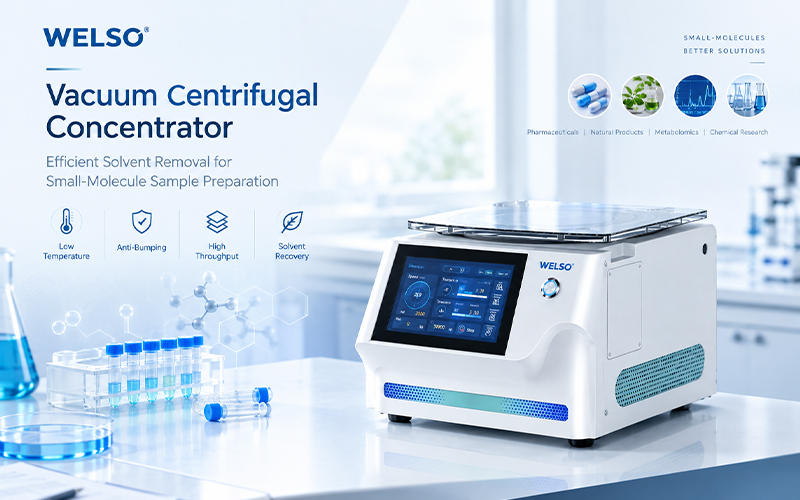
Vacuum centrifugal concentration combines centrifugal force, vacuum, and controlled heating to promote solvent evaporation at relatively low temperatures. At the same time, centrifugal force helps reduce bumping and splashing, making this approach particularly suitable for small-volume samples and applications where gentle sample handling is important.
How Does Vacuum Centrifugal Concentration Enable Gentle Concentration of Small-Molecule Samples?
The principle of vacuum centrifugal concentration is based on combining centrifugal force with vacuum evaporation.
During operation, samples rotate in the rotor under centrifugal force, causing the liquid to spread along the tube wall and form a thin liquid layer. This increases the effective evaporation area and promotes solvent removal. Meanwhile, the vacuum environment lowers the boiling point of the solvent, allowing evaporation to occur under relatively mild temperature conditions.
For commonly used organic solvents such as methanol, ethanol, and acetonitrile, the vacuum and temperature parameters can be adjusted according to the sample properties, solvent system, and desired concentration level. This helps improve evaporation efficiency while reducing the potential thermal impact on the sample.
For small-molecule applications requiring micro-volume sample preparation, a vacuum centrifugal concentrator provides a practical balance between sample protection and concentration efficiency.
In laboratory applications, the Welso WVC-1AL Vacuum Centrifugal Concentrator combines centrifugal concentration with vacuum evaporation and can be used for solvent removal and concentration of proteins, peptides, small-molecule compounds, and other laboratory samples.
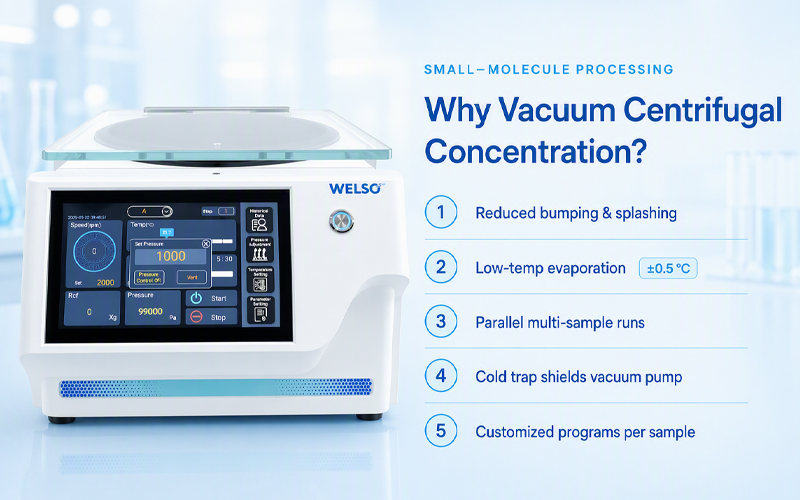
Key Advantages of Vacuum Centrifugal Concentration for Small-Molecule Products
1. Centrifugal Force Helps Reduce Bumping and Splashing
Under vacuum conditions, solvents can boil more readily. If samples are subjected directly to vacuum evaporation, vigorous boiling may cause splashing, potentially affecting sample recovery and experimental consistency.
Vacuum centrifugal concentration uses centrifugal force to help stabilize the liquid during evaporation and reduce splashing caused by bumping. This can help minimize sample loss and the risk of cross-contamination, particularly when working with small sample volumes.
2. Low-Temperature Vacuum Evaporation Reduces Thermal Stress
Reducing system pressure lowers the boiling point of the solvent, allowing evaporation without prolonged exposure to high temperatures.
For certain heat-sensitive small molecules, low-temperature evaporation can help reduce the risk of degradation or structural changes caused by excessive heat. The WVC-1AL provides precise temperature control with an accuracy of up to ±0.5°C, allowing users to establish appropriate concentration conditions for different samples.
The specific temperature and vacuum settings should always be optimized according to the properties of the solvent and the thermal stability of the target compound.
3. Parallel Processing Improves Sample Throughput
Small-molecule research often involves processing multiple samples at the same time, such as samples from different reaction conditions, extraction batches, or experimental time points.
A vacuum centrifugal concentrator enables multiple samples to be processed simultaneously, reducing the time required for individual sample handling. Depending on the configuration, the WVC-1AL can accommodate multiple samples for parallel concentration, making it suitable for batch sample preparation in laboratory workflows.
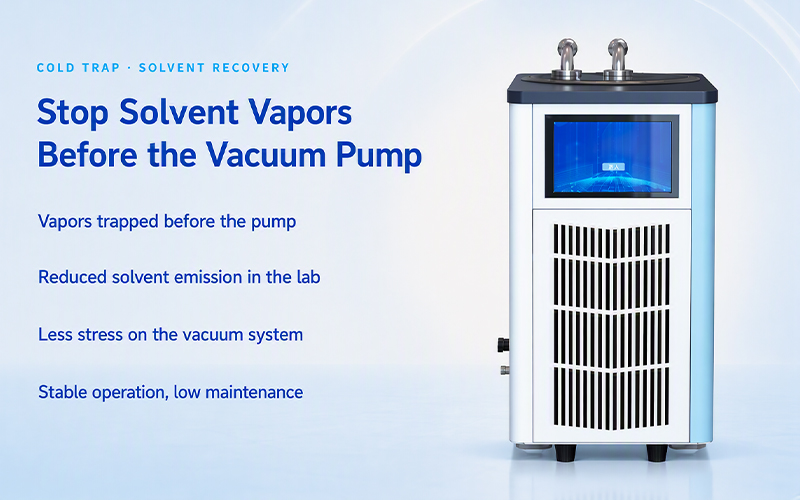
4. Cold Trap Captures Solvent Vapors
During concentration, solvent vapors pass through the cold trap, where they are captured before reaching the vacuum pump.
This helps reduce solvent exposure to the vacuum system and can also reduce solvent emissions in the laboratory. In addition, effective solvent trapping helps protect the vacuum pump and supports stable long-term operation.
5. Flexible Concentration Programs for Different Samples
Small-molecule samples may differ in solvent composition, sample volume, and thermal stability. Therefore, identical concentration parameters may not be suitable for every sample.
Temperature, vacuum level, and operating time can be adjusted according to the characteristics of each sample. For experiments that need to be repeated frequently, programmable operation can also help improve consistency between batches.
Basic Workflow for Vacuum Centrifugal Concentration of Small-Molecule Products
The following workflow can be used as a general reference for laboratory sample preparation:
Step 1: Prepare the Samples
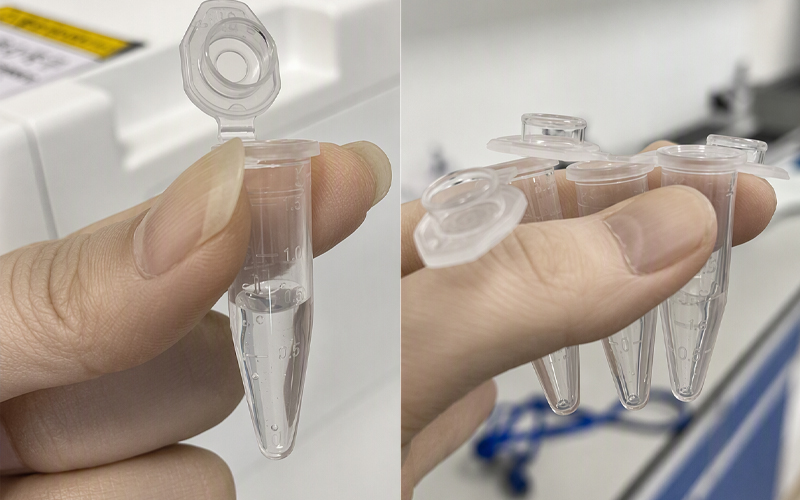
Transfer the small-molecule samples to compatible centrifuge tubes or sample tubes. Ensure that the sample volume is appropriate for the selected rotor and tube specifications.
Step 2: Balance and Load the Samples
Place the sample tubes symmetrically in the rotor according to the equipment requirements to ensure proper rotor balance during operation.
For different tube sizes and materials, confirm that their dimensions and chemical and mechanical resistance are compatible with the equipment and experimental conditions.
Step 3: Set the Concentration Parameters
Set the appropriate temperature, vacuum conditions, and operating time according to the sample properties and solvent system.
For heat-sensitive small molecules, relatively mild temperature conditions are generally preferred. The system pressure can then be adjusted to promote solvent evaporation while minimizing thermal exposure.
Step 4: Start Vacuum Centrifugal Concentration
Once the equipment starts operating, centrifugal force spreads the sample and increases the effective evaporation area, while the vacuum environment promotes solvent evaporation.
The resulting solvent vapors are directed into the cold trap for collection.
Step 5: Stop the Process and Check the Samples
Once the desired concentration level has been reached, stop the process. Wait until the rotor has come to a complete stop before removing the samples.
Depending on the requirements of subsequent analysis, the concentrated samples can then be brought to a defined volume, redissolved, or directly subjected to analysis.
Comparison of Small-Molecule Samples Before and After Concentration
Vacuum centrifugal concentration can effectively remove volatile solvents such as methanol, ethanol, and acetonitrile, allowing relatively dilute samples to be concentrated to a level suitable for subsequent analysis.
However, higher concentration is not necessarily better. For small-molecule samples intended for HPLC, LC-MS, or other analytical methods, the final volume and concentration should be determined according to the requirements of the analytical method. Excessive concentration may affect sample solubility or potentially result in the loss of target compounds.
A before-and-after comparison image of small-molecule sample concentration can be placed here to visually demonstrate the change in sample volume and concentration.
Important Considerations When Concentrating Small-Molecule Products
To achieve more consistent concentration results, the following factors should be considered during the experiment:
Choose an appropriate solvent system.
Different solvents have different boiling points and evaporation characteristics. Concentration parameters should therefore be adjusted according to the actual solvent system.
Control the sample temperature.
For heat-sensitive small molecules, prolonged exposure to elevated temperatures should be avoided whenever possible. Vacuum conditions can be used to promote evaporation at lower temperatures.
▶ Avoid excessive concentration.
Some compounds may precipitate, adsorb to surfaces, or degrade when concentrated close to dryness. The concentration endpoint should therefore be determined according to the requirements of the subsequent experiment.
▶ Use an appropriate sample volume.
Excessive sample loading may reduce evaporation efficiency, while very small volumes may increase the risk of sample loss. Follow the recommended loading range for the equipment and sample tubes.
▶ Ensure effective solvent trapping.
When working with organic solvents, make sure that the cold-trap temperature and trapping capacity are suitable for the expected solvent load. Regular maintenance should also be performed.
Applications in Small-Molecule Research
Vacuum centrifugal concentration can be used not only for the concentration of synthetic small-molecule products, but also for a range of laboratory sample preparation applications, including:
Concentration of pharmaceutical synthesis and reaction products
Concentration of natural product extracts
Enrichment of plant-derived active compounds
Metabolomics sample preparation
Sample concentration before HPLC or LC-MS analysis
Concentration of micro-volume samples in organic solvent systems
Gentle concentration of proteins and peptides
For applications that require a balance of sample integrity, concentration efficiency, and parallel processing capacity, vacuum centrifugal concentration provides a flexible solution for laboratory sample preparation.
The concentration of small-molecule products may appear to be a simple solvent-removal process, but it requires careful consideration of temperature, vacuum level, sample volume, solvent properties, and the stability of the target compound.
By using centrifugal force to help reduce bumping and combining it with vacuum evaporation for low-temperature solvent removal, vacuum centrifugal concentration can improve evaporation efficiency while minimizing the potential thermal impact on sensitive samples.
For laboratories processing multiple small-volume samples or samples that require gentle handling, vacuum centrifugal concentration offers an efficient and practical approach to sample preparation.
The Welso WVC-1AL Vacuum Centrifugal Concentrator integrates centrifugal force, vacuum control, and temperature control to provide an efficient and reliable solution for the concentration and solvent removal of small-molecule products and other laboratory samples.

Subscribe to our Newsletter & Event right now to updated.



+86 21 51096910

sales@welsobio.com
marketing@welsobio.com

1-1009, National Industrial Design Park, No. 599 Jianzhu Road, Binhu, Wuxi , Jiangsu, China, 214062

Head Office: No. 439 Jinglian Road, Minhang District, Shanghai,China, 201108