 +86 21 51096910
 sales@welsobio.com / marketing@welsobio.com




+86 21 51096910
sales@welsobio.com / marketing@welsobio.com
As laboratory centrifuges continue to evolve toward higher speed, greater throughput, and enhanced safety, rotor materials have become increasingly important. Traditional aluminum alloy rotors have served laboratories for many years, but carbon fiber rotors are rapidly becoming the preferred choice for modern centrifuges.
For swing-out rotors in particular, the advantages of carbon fiber are even more significant. Because swing-out rotors carry buckets and fully loaded sample tubes, they have much greater rotational inertia than fixed-angle rotors. Reducing rotor weight delivers noticeable improvements in performance, efficiency, and safety.
1. Lighter Weight, Faster Acceleration
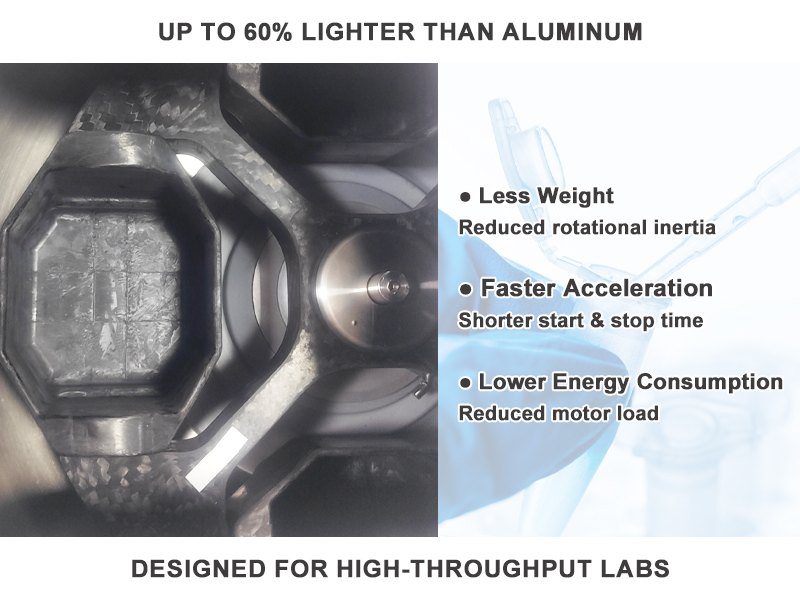
Carbon fiber has a density of approximately 1.6 g/cm³, compared with 2.7 g/cm³ for aluminum alloy. As a result, finished carbon fiber rotors are typically 40–60% lighter than comparable aluminum models.
For swing-out rotors, this lower weight means:
Faster acceleration and deceleration
Reduced motor load
Lower energy consumption
Improved efficiency for high-throughput laboratories
The reduced rotational inertia also helps minimize mechanical stress on the centrifuge drive system during frequent start-stop cycles.
2. Higher Performance Potential
Carbon fiber offers an excellent strength-to-weight ratio and outstanding structural rigidity.
Compared with aluminum alloy, carbon fiber rotors can support:
Higher maximum operating speeds
Larger bucket capacities at equivalent speeds
Stable operation under demanding laboratory workloads
This makes carbon fiber particularly suitable for clinical diagnostics, biotechnology, pharmaceutical research, and other applications requiring high-capacity sample processing.
3. Superior Corrosion Resistance
Rotor durability is heavily influenced by the chemicals routinely encountered in laboratories.
Aluminum alloy rotors rely on an anodized protective surface. Once this layer is scratched or damaged, localized corrosion can develop rapidly, especially when exposed to chloride-containing solutions, strong acids, strong alkalis, or high-salt environments.
Carbon fiber composites, by contrast, combine chemically inert carbon fibers with a high-performance resin matrix, providing excellent resistance to:
Saline solutions
PBS buffer
Cell lysis buffers
Phenol-based reagents
Many acids, alkalis, and organic solvents
For laboratories processing biological samples on a daily basis, improved corrosion resistance can significantly extend rotor service life.
4. Outstanding Fatigue Life
Every centrifuge run subjects the rotor to repeated acceleration and deceleration forces.
Aluminum alloy gradually accumulates microscopic fatigue damage over thousands of operating cycles. Since fatigue cracks often develop internally before becoming visible, aging aluminum rotors require strict service-life management.
Carbon fiber behaves differently. Unlike conventional metals, composite materials exhibit excellent fatigue resistance and maintain their mechanical properties over far more operating cycles.
This contributes to a longer service life and improved long-term reliability when properly manufactured and maintained.
5. Enhanced Safety
Rotor safety is one of the most critical considerations in centrifuge design.
In the unlikely event of severe overload, corrosion damage, or misuse, aluminum alloy rotors may fracture into heavy metal fragments carrying substantial kinetic energy.
Carbon fiber composites fail differently. Their fracture mode generally produces lighter fragments with lower energy release, reducing the potential impact on both personnel and equipment.
Many modern carbon fiber swing-out rotors also incorporate sealed bucket designs that help prevent leaked samples from penetrating the rotor body, further improving operational safety.
6. Autoclavable for Better Laboratory Hygiene
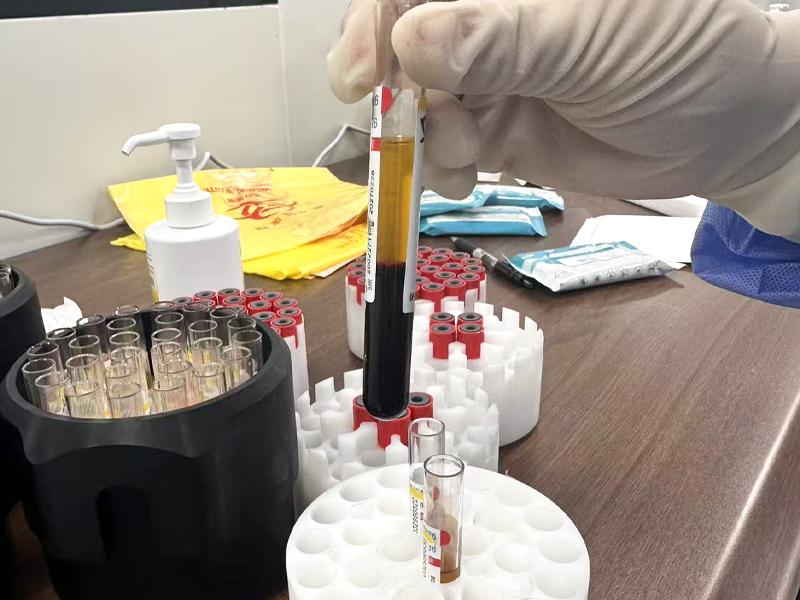
Many carbon fiber rotors are compatible with 121°C steam sterilization, allowing convenient decontamination between experiments.
This is particularly valuable for microbiology laboratories, cell culture facilities, and other applications where contamination control is essential.
Manufacturing Quality Matters
Not all carbon fiber rotors offer the same level of performance.
High-quality carbon fiber rotors require advanced manufacturing processes with optimized fiber orientation and precision molding to ensure maximum structural strength.
Lower-quality products manufactured using simple laminated carbon fiber sheets may be more susceptible to internal delamination or fiber damage following severe impact. Unlike surface scratches on aluminum rotors, internal composite damage may not always be visible and cannot be repaired once it occurs.
For this reason, choosing a rotor from an experienced manufacturer with mature composite engineering and rigorous quality control is essential.
Looking Ahead
Carbon fiber technology represents the next generation of centrifuge rotor design. By combining lightweight construction, excellent corrosion resistance, exceptional fatigue performance, and enhanced operational safety, carbon fiber swing-out rotors provide laboratories with a more durable and efficient solution for demanding applications.
As part of its continuous product innovation strategy, Welso is progressively introducing carbon fiber rotor technology across its centrifuge product portfolio, helping laboratories achieve higher performance, improved reliability, and greater long-term value.

Subscribe to our Newsletter & Event right now to updated.



+86 21 51096910

sales@welsobio.com
marketing@welsobio.com

1-1009, National Industrial Design Park, No. 599 Jianzhu Road, Binhu, Wuxi , Jiangsu, China, 214062

Head Office: No. 439 Jinglian Road, Minhang District, Shanghai,China, 201108