 +86 21 51096910
 sales@welsobio.com / marketing@welsobio.com




+86 21 51096910
sales@welsobio.com / marketing@welsobio.com
Bovine bone is a challenging material for laboratory sample preparation due to its high hardness, dense mineral structure, and fibrous organic matrix. Conventional grinding methods may require considerable time and mechanical effort. Excessive heat generation during processing can also affect the quality of temperature-sensitive components, making sample preparation more difficult for molecular biology and biomedical research.
A cryogenic grinder, also known as a cryogenic grinding mill, offers an effective approach to processing hard biological samples such as bovine bones. By combining low-temperature embrittlement with mechanical impact, the system helps make hard samples easier to fracture and pulverize while limiting heat accumulation during grinding.
At Welso, we provide laboratory sample preparation solutions designed to support efficient and reproducible processing across a range of demanding applications. This article explores how cryogenic grinding can be used for bovine bone samples, including a practical grinding example for subsequent DNA and RNA extraction.
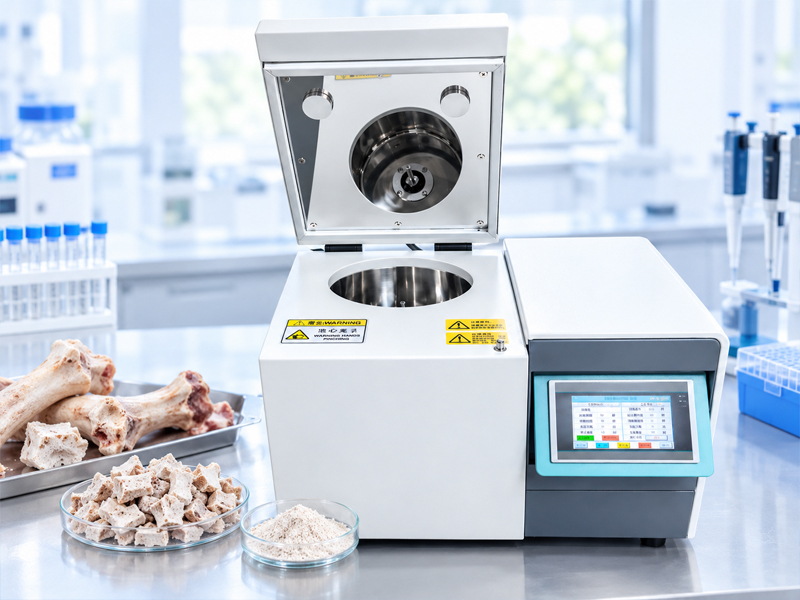
Why Use a Cryogenic Grinder for Bovine Bone Samples?
Bovine bone contains a dense mineral matrix, primarily composed of calcium phosphate minerals, together with collagen and other organic components. These structural characteristics make it difficult to achieve fine, uniform powder using conventional grinding alone.
Cryogenic grinding addresses these challenges through three key advantages.
1. Reduced Heat Accumulation
Mechanical grinding generates frictional heat, which may affect the quality of certain biological components. Cryogenic grinding uses low-temperature conditions to reduce heat accumulation during sample processing.
This approach can help preserve the suitability of samples for downstream molecular analysis. However, DNA, RNA, and protein integrity also depend on sample collection, storage, contamination control, and extraction procedures.
2. Improved Grinding Efficiency for Hard Samples
Low temperatures make many hard biological materials more brittle, allowing them to fracture more readily under mechanical impact. This can facilitate the pulverization of bovine bone and other dense samples, reducing the difficulty of processing materials with high mechanical strength.
3. More Consistent Sample Preparation
Programmable grinding parameters, including frequency, processing time, and temperature where supported by the instrument, help standardize sample preparation.
Once suitable conditions have been established and validated, a cryogenic grinder can help improve batch-to-batch consistency and provide more uniform material for downstream testing.
Cryogenic Grinding of Bovine Bone for DNA and RNA Extraction
The following example illustrates a cryogenic grinding procedure for bovine bone samples. The settings represent a specific experimental configuration and should be validated against the sample characteristics, instrument specifications, and intended analytical method before routine use.
Experimental Setup
Parameter | Example Setting |
Sample | Bovine bone |
Grinding jar | 50 mL stainless steel jar |
Grinding media | One 18 mm stainless steel ball |
Cooling method | Liquid nitrogen pre-cooling |
Grinding temperature | −50°C, where supported by the instrument |
Grinding frequency | 60 Hz, where applicable |
Grinding time | 60 seconds |
Note: The temperature and frequency settings depend on the cryogenic grinder model and its operating configuration. Liquid nitrogen handling, jar compatibility, and the recommended cooling procedure must follow the manufacturer's instructions.
Step 1: Prepare the Bovine Bone Sample
Cut the bovine bone into smaller pieces suitable for the selected grinding jar. The sample size should be compatible with the jar dimensions and the grinder's recommended loading range.
Avoid overloading the jar, as excessive sample volume may restrict movement of the grinding ball and reduce grinding efficiency. For DNA or RNA analysis, use clean tools and minimize the risk of cross-contamination.
Step 2: Pre-Cool the Sample and Grinding Jar
Transfer the prepared sample into a compatible grinding jar and add the specified grinding ball. Pre-cool the assembly using the validated cryogenic procedure.
If liquid nitrogen is used, ensure that the jar and all associated components are designed for the procedure. Follow the instrument manufacturer's instructions for cooling, sealing, and operating the jar. Never seal liquid nitrogen inside a conventional airtight container unless the system is specifically designed and approved for that purpose.
Step 3: Configure the Grinding Parameters
Set the grinding conditions according to the selected instrument and the experimental protocol.
In this example, the target grinding temperature is −50°C, the frequency is 60 Hz, and the grinding time is 60 seconds, provided that these settings are supported by the equipment.
For initial trials, assess the resulting powder's particle size, uniformity, and suitability for the downstream extraction method. If the material remains too coarse, optimize the processing conditions through controlled trials rather than increasing the grinding time indiscriminately.
Step 4: Collect the Ground Sample
After grinding, recover the sample promptly using appropriate tools and procedures. Minimize unnecessary exposure to ambient moisture and temperature fluctuations.
For downstream DNA or RNA extraction, transfer the ground material into suitable clean containers and follow the validated storage and extraction protocol. If molecular integrity is critical, avoid repeated freeze-thaw cycles and unnecessary delays before extraction.
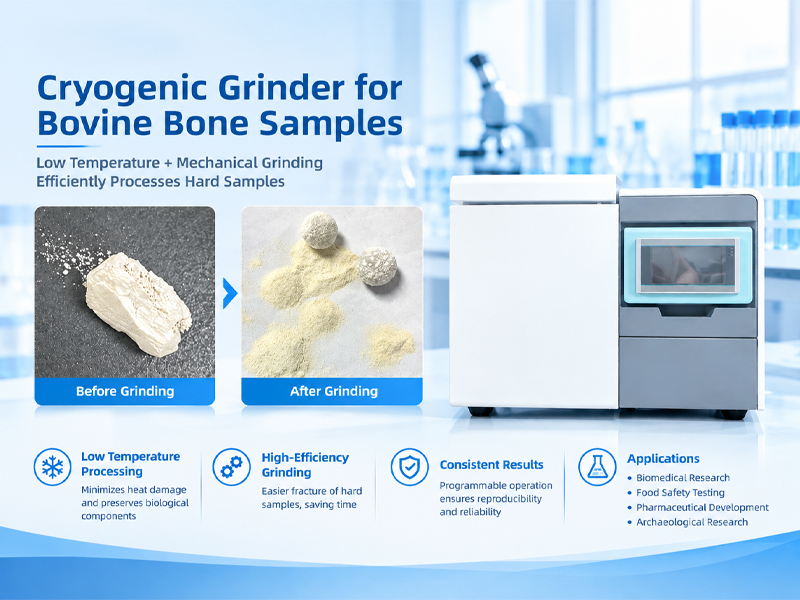
Bovine Bone Grinding Results: What Should Be Evaluated?
A cryogenic grinding test can be used to evaluate whether the selected processing conditions are suitable for bovine bone sample preparation.
When comparing untreated bone pieces with ground material, consider the following indicators:
● Particle size: Whether the sample has been reduced to the required size for the subsequent procedure.
● Powder uniformity: Whether the material has a relatively consistent particle-size distribution.
● Processing efficiency: Whether the selected conditions achieve the target result within an acceptable processing time.
● Downstream suitability: Whether the prepared sample supports the intended DNA, RNA, protein, or other analytical workflow.
In the Welso application example, the objective is to convert hard bovine bone material into fine powder within a short grinding cycle. The actual particle size, grinding yield, and molecular recovery should be confirmed through experimental measurements.
Applications of Cryogenic Grinding Beyond Bovine Bone
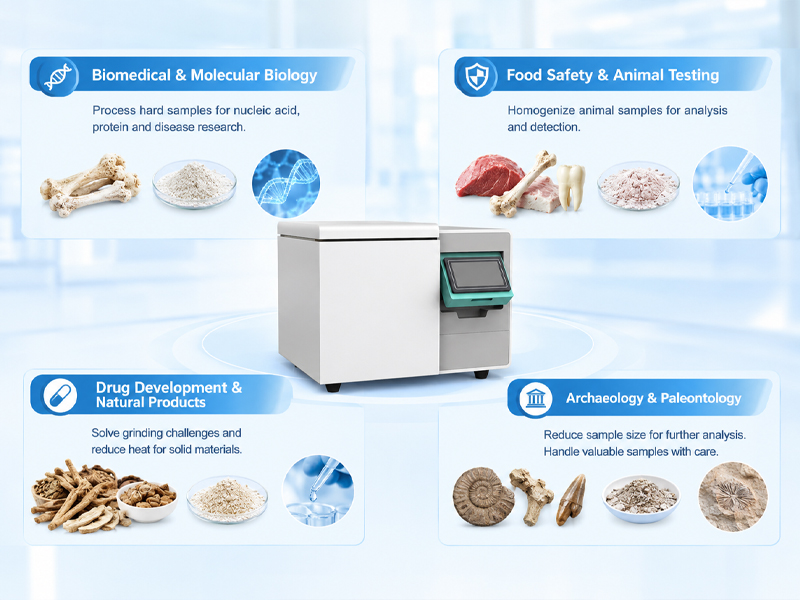
Cryogenic grinding is applicable to a variety of hard, brittle, or temperature-sensitive materials. Depending on the sample properties and validated protocol, potential applications include:
Biomedical and Molecular Biology Research
Cryogenic grinding can facilitate the preparation of bone and other hard biological tissues for DNA extraction, RNA analysis, protein studies, and investigations into bone-related diseases. Downstream analytical results depend on the complete sample preparation and extraction workflow.
Food Safety and Animal Sample Analysis
Animal bones, teeth, and other hard biological materials may require pulverization before chemical, molecular, or contaminant analysis. Appropriate cleaning and contamination-control procedures are essential when processing multiple samples.
Pharmaceutical and Natural Product Research
Certain hard medicinal materials and other solid research samples can be difficult to pulverize using conventional methods. Cryogenic grinding may improve their processability when low-temperature conditions are appropriate for the material.
Archaeology and Paleontological Research
Bone fragments, teeth, and selected fossil materials may require controlled size reduction for subsequent analytical procedures. Sample conservation requirements and the scientific value of the specimen should be considered before grinding.
Important Precautions When Grinding Bovine Bone
To achieve reliable results and maintain laboratory safety, consider the following precautions.
1. Follow liquid nitrogen safety procedures. Wear suitable cryogenic gloves, eye protection, and other required personal protective equipment. Handle liquid nitrogen in a well-ventilated area and follow local safety requirements.
2. Verify jar and grinding media compatibility. Confirm that the jar, grinding ball, seals, and other accessories are suitable for the sample, operating frequency, and cryogenic conditions.
3. Control sample loading. Follow the manufacturer's recommended loading range. Overloading may reduce grinding performance and increase mechanical stress on the equipment.
4. Prevent cross-contamination. Clean and, where necessary, decontaminate the grinding jar and grinding media between samples. Use procedures appropriate for molecular biology applications.
5. Validate the grinding protocol. A single set of parameters may not be suitable for all bone sizes, moisture levels, and research objectives. Evaluate particle size and downstream analytical performance before adopting a routine protocol.
6. Protect molecular sample quality. Low-temperature grinding can help limit heat-related damage, but it does not guarantee complete preservation of DNA, RNA, or proteins. Sample handling, storage, and extraction remain critical.
Why Choose Welso for Laboratory Sample Preparation?
Welso supplies laboratory instruments and consumables for research, testing, and sample preparation workflows. Selecting an appropriate grinding solution requires consideration of sample hardness, required particle size, throughput, temperature control, grinding media, and compatibility with downstream analysis.
For laboratories processing bovine bone and other demanding samples, the appropriate cryogenic grinding configuration should be selected according to the application and verified experimental requirements.
If you are evaluating a cryogenic grinder for bovine bone pulverization, DNA/RNA sample preparation, or other hard biological materials, contact Welso to discuss your sample characteristics and processing objectives.
Welso — Laboratory Instruments and Sample Preparation Solutions

Subscribe to our Newsletter & Event right now to updated.



+86 21 51096910

sales@welsobio.com
marketing@welsobio.com

1-1009, National Industrial Design Park, No. 599 Jianzhu Road, Binhu, Wuxi , Jiangsu, China, 214062

Head Office: No. 439 Jinglian Road, Minhang District, Shanghai,China, 201108